<img height="1" width="1" style="display:none" src="https://www.facebook.com/tr?id=24251303304461540&amp;ev=PageView&amp;noscript=1"> Mediterranean Freight Corridor

Routing: Almería–Valencia/Algeciras/Madrid–Zaragoza/Barcelona–Marseilles–Lyon–Turin–Milan–Verona–Padua/Venice–Trieste/Koper–Ljubljana–Budapest/Ljubljana/Rijeka–Zagreb–Budapest–Zahony (Hungarian–Ukrainian border)
Members: ADIF (Spain), Línea Figueras Perpignan (Spain–France), SNCF Réseau (France), Oc’Via (France), RFI (Italy), SŽ – Infrastruktura (Slovenia), MÁV (Hungary); KTI (Hungary), GYSEV (Hungary) and HŽ Infrastruktura (Croatia)
Legal form: European Economic Interest Grouping
Registered office, Permanent office and One Stop Shop: Milan
Website: www.medrfc.eu

The Mediterranean Corridor is the European most important horizontal rail freight axis, stretching 7,779 km from Spain to the border of the European Union, connecting the Mediterranean basin with Central Europe and Ukraine.

For this reason, the Mediterranean Corridor has a high potential to capture further significant shares of Europe-Asia traffic flows, although these are currently threatened by the conflict in Ukraine.

On its route from East to West, the Mediterranean Corridor is interconnected with seven other rail freight corridors and crosses three of the four main manufacturing areas in Europe: Catalonia, Auvergne-Rhone-Alpes and Piedmont-Lombardy.

In 2024, the combined GDP of the countries crossed by the Mediterranean Corridor accounted for around 40% of the EU’s total GDP, with a population of 191.7 million people (Eurostat data – “Key Figures on Europe”, 2025 Edition). The Corridor connects more than 100 intermodal Terminals, five major Mediterranean sea ports and two important inland ports (Lyon and Budapest).

With regard to trade between Italy and France, the volumes of goods transported through the Frejus Tunnel are shown in the following table (Observation et analyse des flux de transports de marchandises transalpins 2020-2024):


 2020

2021

2022

2023

2024

Total Freight Volumes – Modane Crossing (Thousand Tonnes) 13,088.90 15,162.00 15,926.00 15,189.00 16,632.00
Rail Freight Volumes – Modane Crossing (Thousand Tonnes) 2,406.30 2,677.00 2,337.00 1,378.00 0*
Modal Share – Modane Crossing (%) 18.4% 17% 15% 9% 0*
Total Freight Volumes – Ventimiglia Crossing (Thousand Tonnes) 19,515.70 22,385.00 22,445.00 22,496.00 23,617.00
Rail Freight Volumes – Ventimiglia Crossing (Thousand Tonnes) 633.70 797.00 839.00 827.00 1,228.00
Modal Share – Ventimiglia Crossing (%) 3.2% 3% 4% 4% 5%

*In 2024, rail freight traffic via the Fréjus Tunnel was zero, because the tunnel was closed following a landslide.

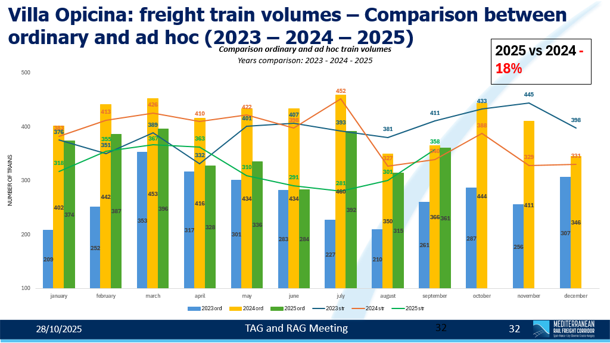
The chart below shows the international freight traffic volume trend on the Villa Opicina border crossing, in terms of number of trains (source: Mediterranean Corridor). 

Villa Opicina freight train volumes comparison ordinary and hoc 2023 2024 2025

For Italy, the Mediterranean Corridor represents an important logistical connection with France to the west and Slovenia to the east, passing through some of the country's most economically advanced regions, including the ports of Venice and Trieste.

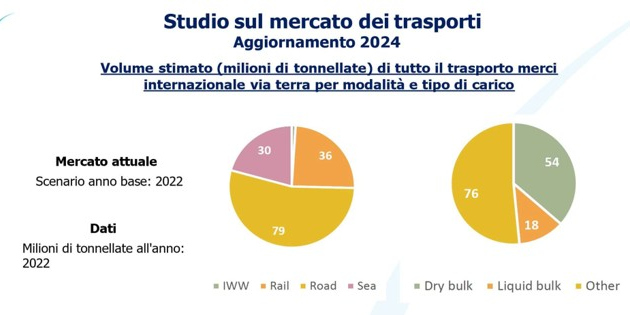
According to the Market Survey the Corridor commissioned to the TPlan -Panteia and completed in early 2025, it is estimated that in 2022 (the survey's reference year) as many as 40,000 freight trains crossed the Mediterranean Corridor, carrying over 36 million tonnes of freight, as shown in the chart below, which also specifies the volumes transported by different modes of transport.

Transport Market Survey 2024 Update Estimated volume (millions of tonnes) of all international land freight transport by mode and cargo type Current market Base - year scenario: 2022 Data Millions of tonnes/year: 2022

These figures show a high freight transport intensity, although not comparable to the Swiss and Austrian passes, with ample room for growth for the rail sector in view of the increasingly pressing need for road decongestion, especially in relation to trade between France and Italy.

The organisation of the Mediterranean Corridor became operational in 2013, in line with the deadlines set by EU Regulation 2010/913.

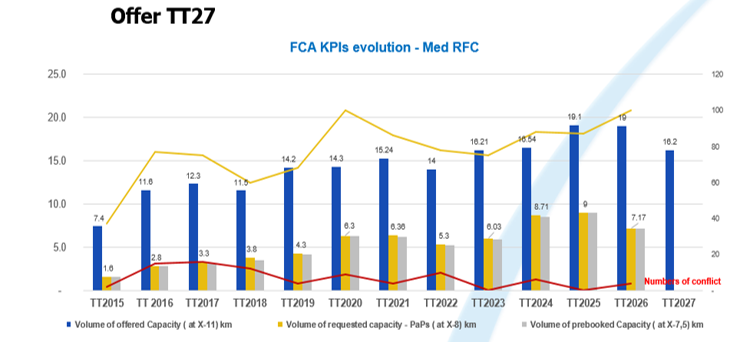
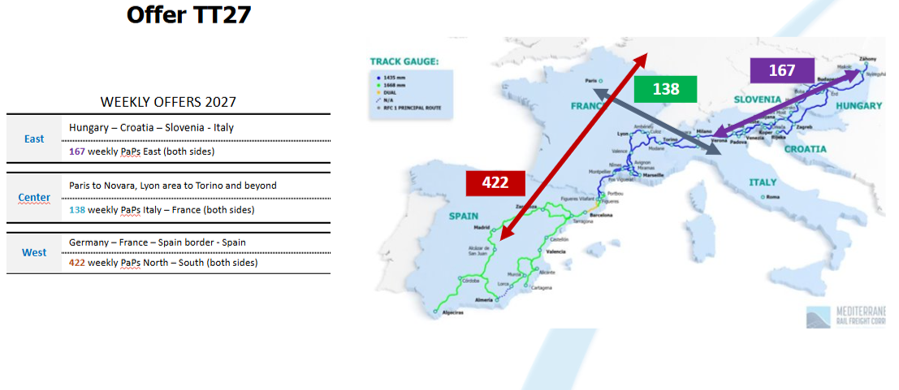
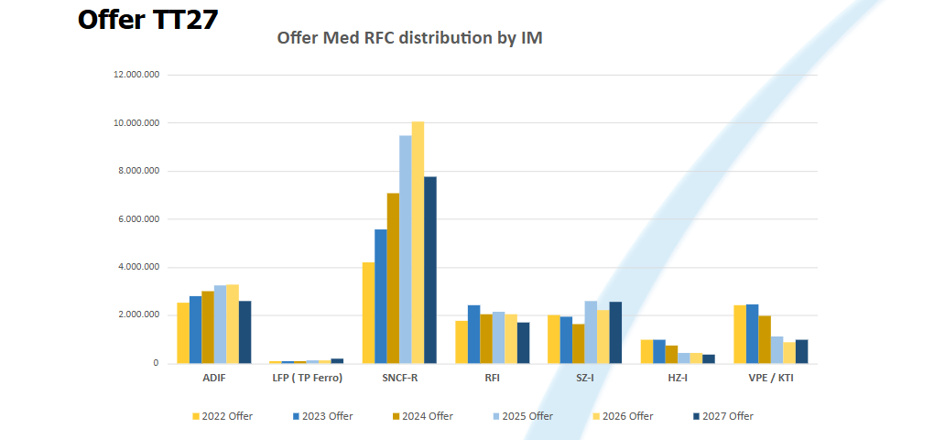
From its establishment until today, the Mediterranean Freight Railway Corridor has seen a steady increase in the ratio of rail capacity offered to demand, stabilising at around 45% in recent years and peaking at 53% for TT- Time Table 2024. The ratio of the rail capacity offered by the corridor to the total planned international capacity offered by the operators has also been gradually increasing, a sign of the increasingly important role played by the corridor as a one-stop shop for the supply of harmonised international capacity (C-OSS - Corridor One Stop Shop). In the TT – Time Table 2027 as well, the total capacity offered exceeded 15 million train-kilometres.

MED RFC allocazione della capacità TT 2027
offer TT27
offer TT27

During 2024–2025, the Mediterranean Freight Corridor updated the Corridor’s Market Survey, in cooperation with the other European rail freight corridors and under the coordination of RailNetEurope (RNE).

The update provides a harmonised analytical framework on international freight traffic trends and on medium- and long-term development scenarios, taking into account changes in the geopolitical context, European transport decarbonisation policies, and the main infrastructural and operational variables.

Preliminary results confirm the growth potential of rail freight transport along the Mediterranean axis, highlighting the Corridor’s strategic role in promoting modal shift and strengthening the resilience of the European logistics chain.

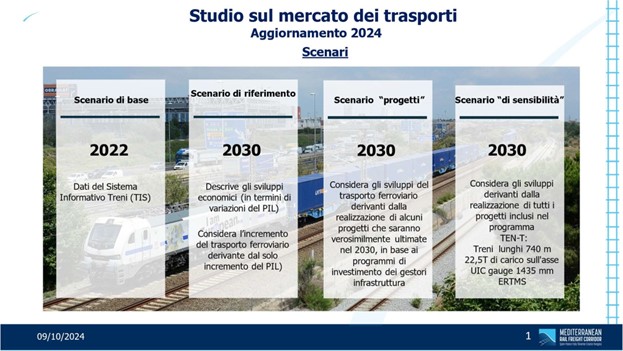
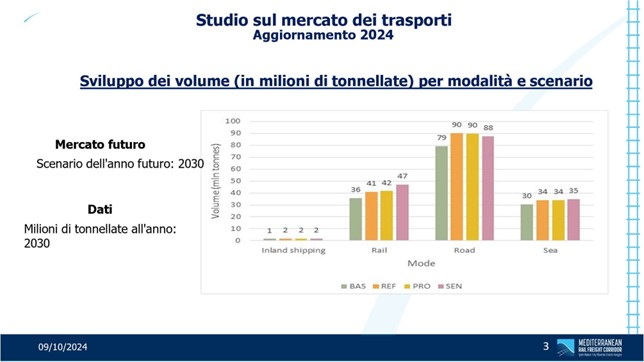
Concerning research data already available, the following charts show the size and composition of the international freight traffic detected on the Mediterranean Corridor (year 2022) and a projection of traffic volumes to 2030, under 4 different hypothesised scenarios.

Transport Market Survey 2024 Update Scenarios Baseline scenario 2022 Data from the Train Information System (TIS) Reference scenario 2030 Describes the economic developments (in terms of GDP growth) Considers the increase in rail transport resulting solely from GDP growth “Projects” scenario 2030 Considers rail transport developments resulting from the implementation of a number of projects that are likely to be completed by 2030, according to the infrastructure managers’ investment programmes “Sensitivity” scenario 2030 Considers the developments resulting from the implementation of all the projects included in the TEN-T programme: 740 m long trains 22.5 tonnes of axle load 1435 mm UIC gauge ERTMS
Transport Market Survey 2024 Update Volume growth (in millions of tonnes) by mode and scenario Future market Scenario for the year ahead: 2030 Data Millions of tonnes/year: 2030

Activities to improve circulation at border points

QCO (Quality Circle Operation) Villa Opicina-Sežana 

In 2024 and 2025, the Villa Opicina–Sežana Task Force continued the activities undertaken in previous years to improve railway traffic between Italy and Slovenia. The priority objective is to achieve a significant reduction in the dwell time of freight trains in the Villa Opicina station, to prevent congestion that sometimes disrupt traffic on the entire eastern section of the Mediterranean Corridor. From mid-2024, a systematic day-by-day and train-by-train monitoring of dwell times was introduced, with data shared between the infrastructure managers and the railway undertakings concerned. This approach has led to greater operational transparency and the targeted identification of the main critical issues, laying the foundations for structured corrective measures. In 2025 and 2026, the Corridor is continuing to fulfil its coordinating role, with the primary aim of preventing traffic congestion and ensuring greater flow reliability along the eastern section of the Mediterranean Corridor. 

QCO (Quality Circle Operation) Modane 

With the involvement of RFI and SNCF Réseau, the Corridor has launched a similar initiative, aimed at reducing border transit times through the identification of joint initiatives with railway companies, also in anticipation of the construction of the new Turin-Lyon link.

In 2024, the Mediterranean Corridor continued to play an active coordinating role, following the landslide that occurred in August 2023 in the Maurienne Valley, which led to the disruption of railway links between Italy and France.

Throughout 2024 and into early 2025, the Corridor supported the International Contingency Management (ICM) processes, facilitating dialogue between infrastructure managers, operators and local authorities, and monitoring the rerouting solutions adopted.

The railway line reopened in March 2025. The Corridor will continue to monitor the developing situation and promote measures to improve cross-border rail traffic, considering also that the closure of the border crossing led to a significant loss of competitiveness for rail transport against road transport.

QCO (Quality Circle Operation) Perpignan-Barcelona

During the meeting held in Madrid in 2023, between the Mediterranean Corridor and ADIF, the “QCO Perpignan - Barcelona” Task Force was launched, with the aim of facilitating and improving cross-border cooperation between the three Managers - ADIF, SNCF Réseau and LFP - and all other stakeholders. The priority objectives identified are as follows:

  • Optimisation of management procedures at Perpignan Station.
  • Further development of the QCO BCP Perpignan-Barcelona, extended to operators and public authorities.

During 2024, the activities of the Perpignan–Barcelona Quality Circle Operation evolved from the start-up phase to a structured cooperation between the Infrastructure Managers involved and the other operational stakeholders. In 2025 and 2026, the Corridor is continuing to develop the QCO, assessing further operational measures – including possible extensions to night-time operating windows and further traffic management optimisation – to increase the reliability of the French-Spanish section, and full exploitation of its available capacity.

Managing unplanned interruptions (ICM – International Contingency Management) and planned interruptions due to maintenance works (TCR – Temporary Capacity Restriction)

In 2025, the Mediterranean Corridor monitored and managed major infrastructure disruptions along the main cross-border routes. The reopening of the Culoz–Modane line and the Fréjus Tunnel on 31 March 2025 marked a crucial milestone, after the prolonged disruption caused by landslides in the Maurienne Valley. However, infrastructure repair work and further adverse weather conditions led to additional operational restrictions during the early summer months of 2025, which required a phased restoration of the capacity, which reached its full potential by mid-July 2025.

At the same time, the Corridor managed other line closures linked to modernisation and infrastructure development works, such as the suspension of services on the Guadalajara–Santa María de Huerta section, and restrictions on the Rubí tunnel in Spain. 

These events only confirmed the importance of a coordinated approach to the way Temporary Capacity Restrictions and International Contingencies are managed, reinforcing the Corridor’s role as a platform for cooperation between infrastructure managers, railway operators and institutional stakeholders.
On 18 July 2024, the new European Regulation (EU) 1679/2024 came into force, revising the regulatory framework for the TEN-T Networks. According to this Regulation, the Rail Freight Corridors routing will match that of the nine multi-modal European Transport Corridors (ETC), of which the Rail Freight Corridors will be a part of. There are currently 9 European Transport Corridors.

In addition, the new Regulation expands the Rail Freight Corridors’ responsibilities in terms of performance targets within the set deadlines. In particular, the governance of the Rail Freight Corridors is responsible for taking all necessary measures to achieve the target transit time at the border (25 minutes), and punctuality on arrival (75% of incoming trains with delays of less than 30 minutes).

In this regard, the Corridor’s governance acts in cooperation with freight transport stakeholders and with the other Corridors to improve the overall performance.

The Mediterranean Corridor collaborates closely with the ETC’s European Coordinator to monitor these operational priorities set out in the new Regulation.

The Mediterranean Freight Corridor, in line with the new regulatory provisions and in continuity with the aspects already initiated and implemented in previous years, will focus its efforts in the medium term on the following items:

  • Improving border transits, by carrying out actions to develop greater interoperability and to ensure regular monitoring of traffic in order to identify and implement corrective actions to decrease transit times, increase punctuality, and ensure greater transport reliability;
  • improving performance monitoring with a focus on improving data reliability and greater computerisation of information management;
  • Developing an international capacity offer increasingly in line with the needs of the end users, by enhancing the coordination with terminals and ports.
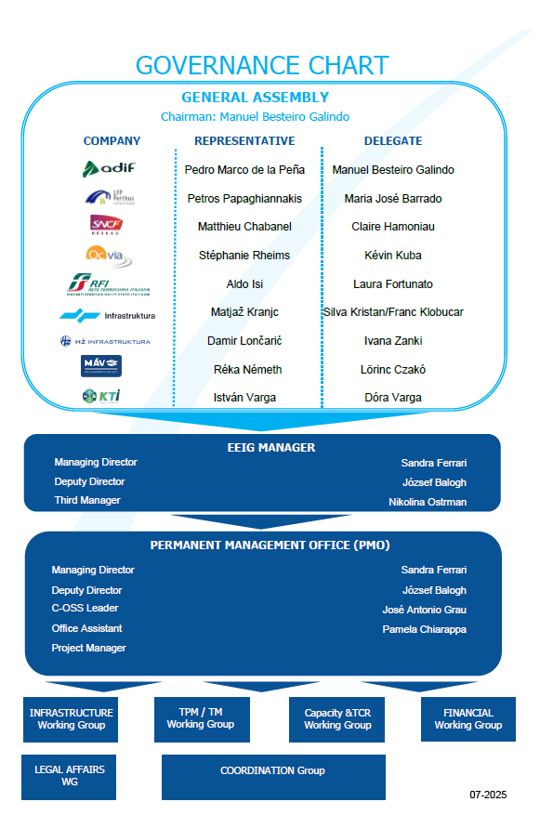
Organizzazione corridoio merci mediterraneo