<img height="1" width="1" style="display:none" src="https://www.facebook.com/tr?id=24251303304461540&amp;ev=PageView&amp;noscript=1"> TEN-T Corridors

The Trans-European Transport Network for an increasingly connected and sustainable Europe

On 13 June 2024, the new Regulation (EU) 2024/1679 on EU guidelines for the development of the Trans-European Transport Network (TEN-T) was adopted, repealing previous Regulation (EU) 1315/2013 and amending Regulation (EU) 913/2010 that established the Rail Freight Corridors.

The new Regulation significantly reinforces the EU's commitment to building an integrated, sustainable and resilient network as the backbone of the single market, which will improve connectivity, economic and social cohesion between European regions.
Purposes of the TEN-T Regulation:

  • Decarbonising transport by providing an adequate infrastructure network capable of reducing traffic congestion, and therefore emissions and pollution;
  • Building a multimodal and interoperable network throughout Europe with high-quality standards to better integrate urban nodes into the network;
  • Increasing the resilience of all infrastructures with respect to climate change, natural hazards and man-made disasters;
  • Developing innovative solutions for a greater digitisation and automation of transport processes;
  • Improving the efficiency of TEN-T network governance tools and streamlining investment projects’ communication and monitor tools.

Some of the new aspects introduced by the Regulation is the shift from a two-tier structure - Central Network and Comprehensive Network - to a three-tier network structure:

1. Core Network: Includes the most important connections between nodes, such as urban nodes, ports, airports and border crossing points, and its completion is scheduled by 2030. 

2. Extended Core Network: Intermediate layer between the Core Network and the Global Network, which will fill any gaps in strategic links. The Extended Core Network includes the Comprehensive Network’s priority routes, part of the European transport corridors. It was introduced to anticipate the completion of large-scale, mainly cross-border projects, such as the missing rail links by 2040. 

3. Comprehensive Network: Ensures coverage of the entire EU territory and accessibility to all regions. This network consists of all the existing and planned transport infrastructures that will help achieve territorial cohesion objectives. It complements and interconnects the Core Network. Its completion and full interoperation is expected by the end of 2050.
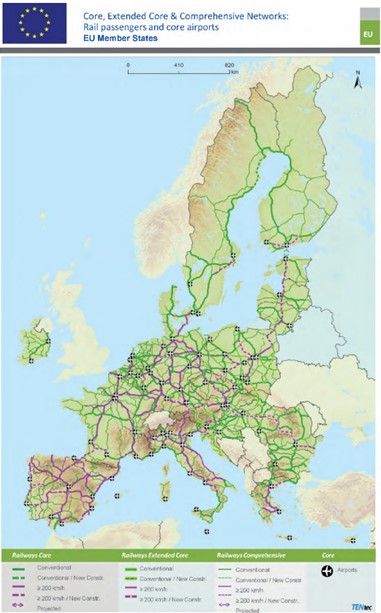
Rail passengers and core airports EU Members States
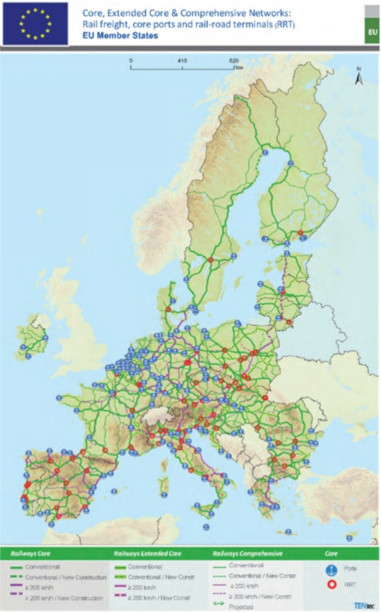
Rail freight, core ports and rail-road terminals EU Members States

Purpose of the Regulation is building a reliable, interoperable and high-quality transport network, by introducing new infrastructure requirements and operational priorities, which complement the parameters already provided for in previous Regulation (EU) 1315/2013. For the railway mode, these parameters include:

  • A passenger speed of 160 km/h on passenger lines belonging to the Core and Extended Core Network by 2040;
  • Loading gauge for transport of 4m-high semi-trailers on wagons at least 27cm above the rail level on the freight lines of the Core and Extended Core Network by 2040;
  • Integration of the 740m train length requirement with provision of at least a 740m train path offer on single and double track freight lines, where required by the market;
  • Implementation of the single European signalling system - ERTMS - on the entire TEN-T Network, along with the obligation to decommission class B systems by 2040 on the Core Network, by 2045 on the Extended Core Network, and by 2050 on the Comprehensive Network. In addition, each Member State shall designate a national representative responsible for ERTMS implementation to participate in the ERTMS Consultative Forum;
  • The operational priorities to be implemented by 2030 on freight lines by the governance structures of the Freight Rail Corridors, to enable greater synergies between infrastructure planning and transport service operation:
    - No more than 25 minutes of average waiting time at the borders
    - Arrival at destination with a maximum delay of no more than 30 minutes
    for at least 75% of international goods trains.

As far as logistics are concerned, the new Regulation provides for an increased capacity and quantity of logistic terminals to adapt to the forecast traffic demand for the coming decades. The increase and efficient management of capacity within the terminals shall be achieved through the option of accommodating 740-metre trains, to foster multi-modality and promote a modal shift from road to rail.

Another new aspect introduced by the Regulation, in response to the impact caused by the Russian/Ukrainian war, and to ensure improved connections with key neighbouring countries, is the extension of four European transport corridors of the TEN-T Network to Ukraine and Moldova, and the discontinuation of cross-border connections with Russia and Belarus. In addition, in order to cope with international tensions, the new trans-European transport network guidelines also emphasise 'military mobility', urging member states to consider implementing dual rail requirements for civil and military mobility, when planning investments for infrastructure construction or modernisation.

Lastly, sustainability is central in the new TEN-T Regulation. In the 432 largest urban centres in the Union - 50 of which are located in Italy - TEN-T networks will have to provide Sustainable Urban Mobility Plans (SUMP) to promote low- or zero-emission mobility. The modal shift, intermodality, the use of digitalisation and new technologies to improve the efficiency of transport systems, and strengthening the role of maritime and rail transport over short and medium distances, all go in the direction of decarbonising logistics, in line with the goal of a 90% reduction of emissions by 2050 for the entire European transport sector, as set out in the 'European Smart and Sustainable Mobility Strategy'.

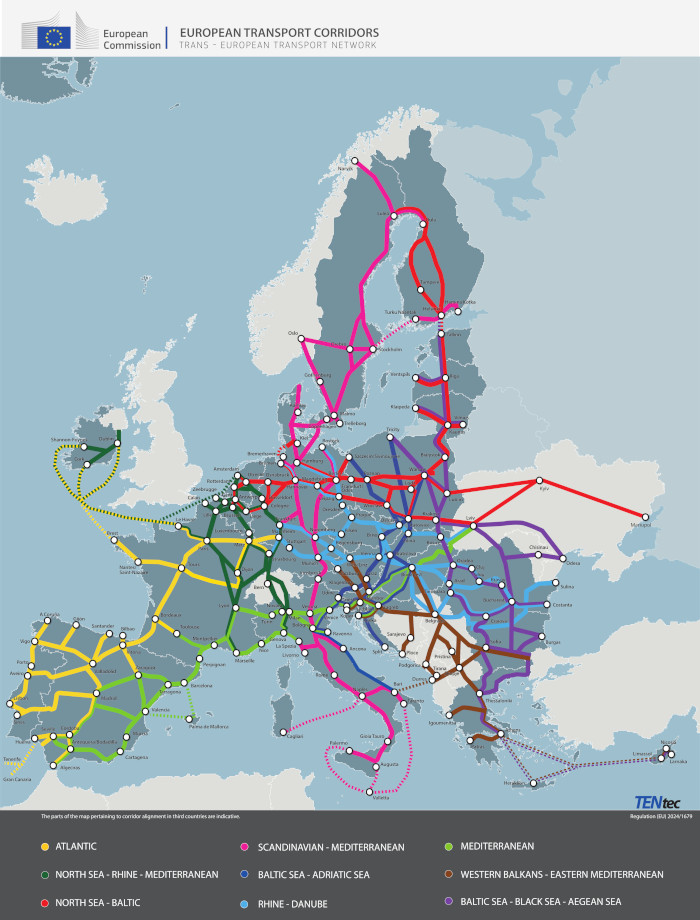
To ensure that infrastructure planning matches actual operational needs, by integrating rail, road and waterways, the new regulation aligns Core Network corridors with rail freight corridors in the so-called "European transport corridors". 

European transport corridors consist of those parts of the Core or Extended Core Networks of the highest strategic importance for the development of sustainable and multimodal freight and passenger transport flows in Europe, and for the development of interoperable infrastructure of high quality and high operational performance. As stipulated in Article 11, there are nine European transport corridors:

1. Atlantic Corridor

2. North Sea - Rhine - Mediterranean Corridor

3. North Sea - Baltic Corridor

4. Scandinavian - Mediterranean Corridor

5. Baltic Sea - Adriatic Sea Corridor

6. Rhine - Danube Corridor

7. Mediterranean Corridor

8. Western Balkans - Eastern Mediterranean Corridor

9. Baltic Sea - Black Sea - Aegean Sea Corridor

The 5 European Transport Corridors (ETC) that affect Italy, and their European coordinators are:

  • Scandinavian-Mediterranean Corridor, whose routing changes to include the Pisa-Rome, Rome-Cassino-Naples, Taranto-Metaponto-Paola and Messina-Cefalù-Palermo lines. Pat Cox was confirmed as Coordinator.
  • Mediterranean Corridor: the Turin-Trofarello-Alessandria and Vicenza-Portogruaro lines have been newly included, while the Savona-Ventimiglia and Genoa-La Spezia lines (for freight purposes only) have been removed. Mathieu Grosch was appointed as new Coordinator.
  • North Sea - Rhine - Mediterranean Corridor (merger of the former Rhine-Alps corridor and the former North Sea-Mediterranean corridor): the Genoa-Savona, Genoa-Tortona via Mignanego and Gallarate-Luino have been included. Pawel Wojciechowsk was confirmed as Coordinator.
  • Baltic Sea - Adriatic Sea Corridor (the former Baltic-Adriatic corridor): routing is extended from Ancona to Bari and also includes the: Monfalcone (Bivio San Polo)-Gorizia-Udine, Udine-Treviso-Venezia, Treviso-Castelfranco Veneto-Padova, Ferrara-Ravenna lines. Anne Elisabet Jensen was confirmed as Coordinator.
  • Western Balkans - Eastern Mediterranean Corridor, in which Italy is connected from the north by the inclusion of the 'Trieste-Villa Opicina' railway section, and from the south by the new 'Bari-Durazzo' maritime section, the Baltic - Adriatic Corridor, where Marian-Jean Marinescu was appointed as new Coordinator.

In addition to the European transport corridors, there are the horizontal priority corridors of the ERTMS and the European maritime space. In order to ensure the coordinated implementation of ERTMS throughout Europe, the Commission confirmed the appointment of Matthias Ruete as European ERTMS Coordinator.