<img height="1" width="1" style="display:none" src="https://www.facebook.com/tr?id=24251303304461540&amp;ev=PageView&amp;noscript=1"> North Sea-Rhine-Mediterranean Freight Corridor

Routing: Le Havre / Dunkirk – Antwerp‑Bruges – Rotterdam – Duisburg – Cologne – Luxembourg – Lyon – Basel – Novara / Milan – Genoa / Marseille‑Fos
Members: ProRail (Netherlands); Infrabel (Belgium); SNCF Réseau (France); ACF (Luxembourg); CFL (Luxembourg); DB InfraGO (Germany); SBB Infrastruktur (Switzerland); BLS Netz (Switzerland); TVS (Switzerland); RFI (Italy); FERROVIENORD (Italy);
Legal form: European Economic Interest Grouping (EEIG);
Registered office: Luxembourg (Grand Duchy of Luxembourg);
Website: www.corridor-nsrm.eu


Under Regulation (EU) 2024/1679 on Union guidelines for the development of the Trans-European Transport Network (TEN-T), Irelandis included  in the North Sea–Rhine–Mediterranean ETC routeHowever, it has exercised  the option provided by the  Regulation not to participate in the RFC’s governance structure (the relevant railway lines are therefore shown as dotted lines)

The North Sea–Rhine–Mediterranean rail freight corridor spans approximately 12,150 km of railway network and is one of the continent’s busiest rail freight routes, linking the major North Sea ports of Haropa, Calais, Dunkirk, North Sea Port, Antwerp-Bruges, Moerdijk, Rotterdam and Amsterdam with the Mediterranean ports of Marseille/Fos‑sur‑Mer and Genoa.

The Corridor crosses some of the most important industrial and logistics regions of Central Europe, including the Rhine‑Ruhr and Rhine‑Main areas in Germany, as wll as key logistics hubs such as Basel. The Corridor then continues southwards through Switzerland,  a crucial transit country for north‑south traffic, via the Gotthard, Lötschberg and Simplon Alpine crossings, before extending into northern Italy, covering the industrial and logistics area around Milan and Novara, and reaching the main western Mediterranean ports.

Established in 2025 following the merger of the former North Sea–Mediterranean and Rhine–Alpine freight corridors, under  Regulation (EU) 2024/1679, the North Sea–Rhine–Mediterranean Corridor is a strategic axis for European rail freight transport, handling high volumes of international traffic volumes and promoting integration among ports, industrial areas and markets along along Europe's north-south axis.

The Alpine passes between Switzerland and Italy (Gotthard and Simplon) see a high percentage of rail freight traffic, with rail transport accounting for approximately 88.2% of the modal split at the Simplon Pass and 69% at the Gotthard Pass in 2024.

The figures below  show the volumes of goods transported through the Gotthard and Simplon passes, which belong to the former Rhine-Alpine Corridor route and, under the new regulatory framework established by Regulation (EU) 2024/1679, are now included in the North Sea-Rhine-Mediterranean Corridor (source: 18th Annual Report of the Observatory on Road and Rail Freight Transport in the Alpine Region):

  2020 2021 2022 2023 2024

Total Freight Volumes Valichi Gottardo (Chiasso+Luino) - Thousand Tonnes

22,431.6 25,312.6 27,308.5 25,467.7 25,866.0

Rail Freight Volumes Valichi Gottardo (Chiasso+Luino) - Thousand Tonnes

15,291.2 17,913.5 19,609.3 18,135.8 17,837.0

Modal share Valichi Gottardo (Chiasso+Luino) – Percentage

68.2% 70.7% 71.8% 71.2% 68.95%

Total Freight Volumes Valico Sempione - Thousand Tonnes

10,767.8 11,373.5 9,802.4 9,592.3 8,872.0

Rail Freight Volumes Valico Sempione - Thousand Tonnes

9,716.4 10,445.2 8,691.1 8,501.8 7,825.0

Modal share Valico Sempione - Percentage

90.2% 91.8% 88.6% 88.6% 88.2%

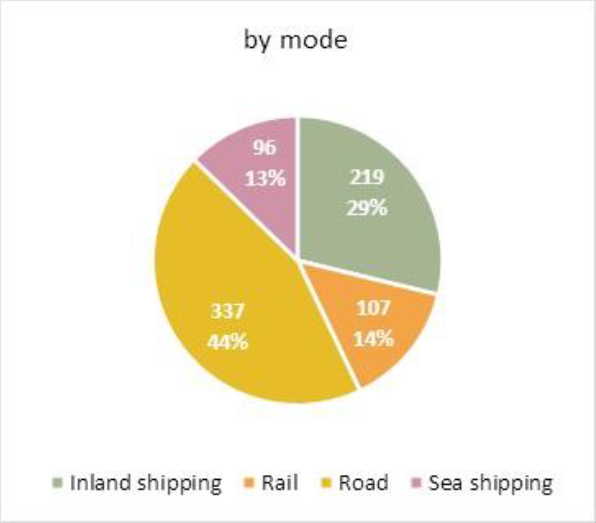
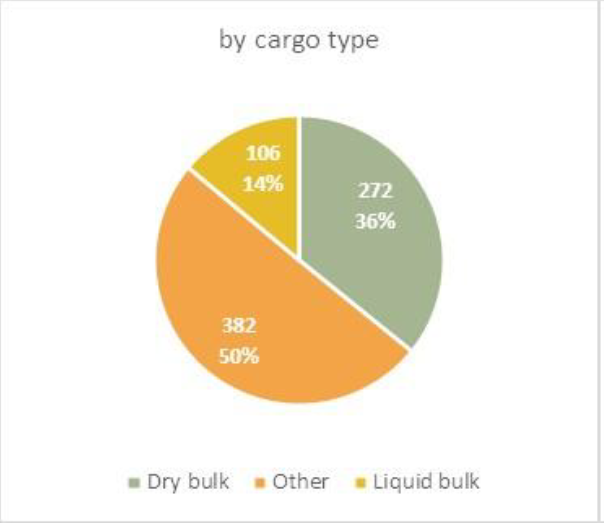
According to the Market Survey commissioned by the Corridor and carried out by the TPlan -Panteia, which was  completed in early 2025, an estimated 178,000 freight trains operated along the North Sea-Rhine-Mediterranean Corridor in 2022 (the reference year of the study),  carrying approximately 107 million tonnes of freight. The chart below, also provides a breakdown of the volumes transported by different.

grafico volumi merci by mode
grafico volume merci by cargo type

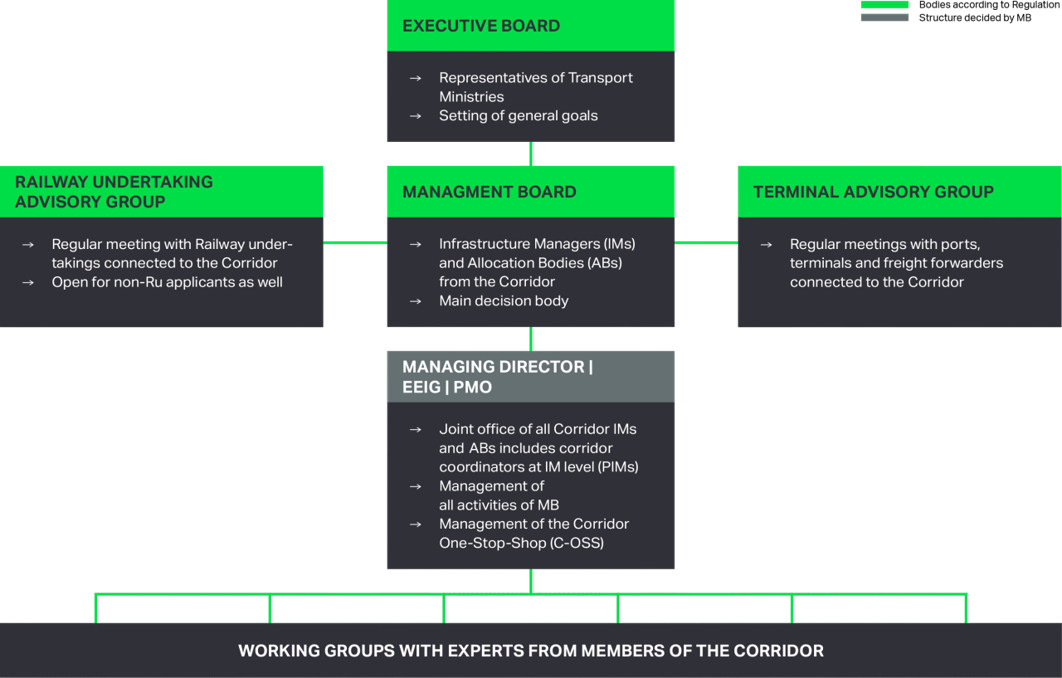
In 2025, the new governance model of the North Sea–Rhine–Mediterranean Rail Freight Corridor model was launched, in accordance with Regulation (EU) 2024/1679 (the TEN‑T Regulation). As early as one year before the Regulation was officially published, joint meetings had already been initiated between the Infrastructure Managers and the Capacity Allocation Bodies of the two predecessor Freight Corridors, with a view to laying the foundations for future cooperation within the new Corridor. This process led to the integration of the former North Sea–Mediterranean and Rhine–Alpine freight Corridors into a single governance structure, with the official establishment of the North Sea–Rhine–Mediterranean Rail Freight Corridor EEIG.

Following the revision of the previous governancethe North Sea–Rhine–Mediterranean Rail Freight Corridor published its Implementation Plan, in July 2025 drawn up jointly by the Executive Board and the Management Board in line with the new regulatory framework introduced by Regulation (EU) 2024/1679.

Transparency and stakeholder involvement were among the key priorities,supported by   a structured consultation process involving the Corridor’s advisory groups, the outcomes of which have been incorporated in the document. The Implementation Plan serves as the framework for the Corridor’s activities over the coming years, and and supports theiralignment with the European Coordinator’s work plan, including the planning of priority infrastructure projects.

During 2024–2025, the Rhine–Alpine and North Sea–Mediterranean freight corridors – which subsequently merged to form i the new North Sea–Rhine–Mediterranean Corridor – updated the Corridor’s Market Survey, in cooperation with the other European rail freight corridors and under the coordination of RailNetEurope (RNE). The update Market Survey provides a harmonised analytical framework on assessing  international freight traffic trends and  medium- and long-term development scenarios, taking into account changes in the geopolitical context, European transport decarbonisation policies, and the main infrastructural and operational factors.In January 2026, the first joint catalogue of pre-arranged international rail paths (PaP) was published for the TT2027 timetable of the new  established North Sea–Rhine–Mediterranean Rail Freight Corridor.
On 18 July 2024, the new Regulation (EU) 1679/2024 came into force, revising the regulatory framework for the TEN-T Network. According to this Regulation, the routing of Rail Freight Corridors will be aligned with that of the nine multimodal European Transport Corridors (ETC), of which theRail Freight Corridors form part. There are currently nine European Transport Corridors.

In addition, the new Regulation expands the Rail Freight Corridors’ responsibilities with regard to meeting performance targets within the prescribed deadlines. In particular, the governance of the Rail Freight Corridors are responsible for taking all necessary measures to achieve the target border transit time (25 minutes), and arrival punctuality rate (75% of incoming trains with delays of less than 30 minutes).

In this regard, the Corridor’s governance works in cooperation with freight transport stakeholders and other Corridors to improve overall performance.

Alongside performance targets, a particularly critical area is the coordination of infrastructure works planned along the Corridor, which are essential for ensuring service continuity and quality in a context characterised by a significant increase in infrastructure works and the resulting impact on available capacity. This situation highlights the growing need to strengthen international coordination, also including through dedicated task forces and working groups that facilitate early cooperation between Infrastructure Managers. Building on the experience gained in the two previous Corridors, the coordination of Temporary Capacity Restrictions (TCRs) continues to be carried out through bilateral and multilateral working groups along the Corridor, with experts from the countries involved working together to minimise the impact of construction works on freight traffic and ensure the continuity of the international rail freight flow.

organizzazione corridoio merci nsrm