The constant focus on the market requires an increasing involvement of end customers in the supply chain. The Scandinavian-Mediterranean Freight Corridor therefore intends to simplify access to the network and the services offered to transport companies and shippers, in order to make the use of railways easier and more convenient. In this respect, the Terminal Integrated Capacity Offer (TICO) is an important product, which, born as a pilot project, it has then become an integral part of the commercial offer of the Corridor involving an increasing number of terminals. The integrated commercial offer is currently being refined in consideration of the feedback from the railway companies.
In 2020, the second phase of the preliminary study “Longer and Heavier Trains”, aimed at estimating, for different time horizons, the capacity supply for the circulation of longer and heavier trains taking into account market developments and planned infrastructure investments, was completed. In January 2025, the ScanMed RFC Corridor took part in a field trial to assess the operational performance of longer trains. From 1 June 2025, following the introduction of new braking tables, updated regulations came into force, authorising the passage of freight trains up to 850 metres long on the Öresund - Malmö (Sweden) section. Trains measuring 835 metres were already in service in Denmark and on the route connection the Maschen railway yard, south of Hamburg, and Padborg, on the German-Danish border. Following these changes, the Maschen–Padborg–Malmö strategic axis is now ready to accommodate trains up to 835 metres long, thereby increasing the capacity and efficiency of international rail transport along the ScanMed corridor.
During 2024–2025, the Scandinavian-Mediterranean Freight updated the Corridor’s Market Survey, in cooperation with the other European rail freight corridors and under the coordination of RailNetEurope (RNE). The update provides a harmonised analytical framework on international freight traffic trends and on medium- and long-term development scenarios, taking into account changes in the geopolitical context, European transport decarbonisation policies, and the main infrastructural and operational variables.
The Scandinavian-Mediterranean Corridor was the first European freight corridor to apply the International Contingency Management (ICM) - an international emergency management process shared by all European infrastructure managers in the event of unplanned disruptions to international rail traffic - in a real case, to manage the disruption of rail traffic that occurred on the Italian network, along the Brenner adduction line in December 2020.
The Munich-Verona line is a key link in the Scandinavian-Mediterranean Freight Corridor, of which the future Brenner Base Tunnel (due to become operational in 2032) will be a key strategic infrastructure for the efficient international transport of goods. Considering the positive results achieved in the pilot project, the Brenner Axis Task Force developed actions applied to the southern section of the Corridor which, starting with the definition of a new optimised short-term planning procedure and the introduction of a new communication flow between the Control rooms, have led to the implementation on a permanent basis of a structured system of periodic performance monitoring. Quality dialogues were developed within this framework, as structured, ongoing technical consultation processes between infrastructure managers and railway undertakings. They facilitate a shared operational performance assessment and the coordinated identification of measures to improve the quality and reliability of the service along the Corridor.
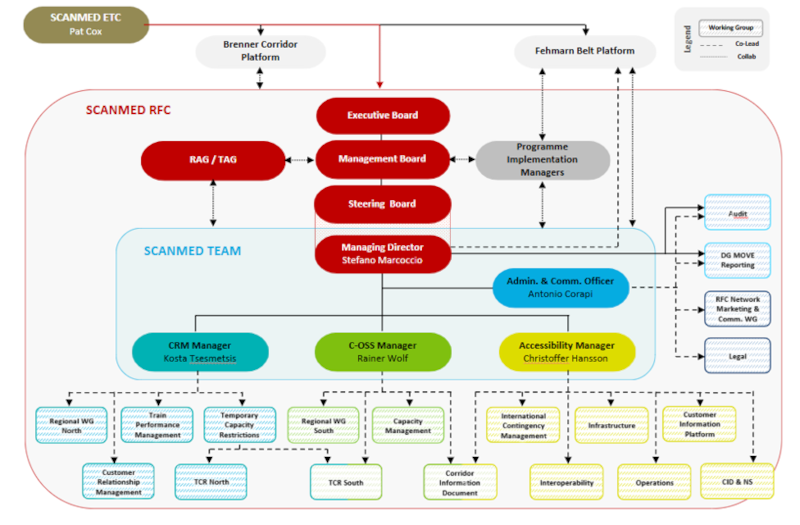
These operations were carried out to complement the activities of the international Brenner Corridor Platform (BCP), which works with railway experts to develop proposals concerning infrastructure improvement, train path management, terminal handling and issues of interoperability, logistics and environmental impact with a time perspective after the opening of the Brenner Base Tunnel. As recognised by the European Commission, this initiative represents a reference and best practice for other Rail Freight corridors, and the European rail network in general.
Under the leadership of European Coordinator Pat Cox and with the active contribution of the Scandinavian-Mediterranean Freight Corridor, the BCP, after an initial consolidation phase, has begun producing concrete results. Among those worthy of notice, a joint forecast of traffic flows for passengers and freight in 2030 and 2040, and an assessment of the available capacity of the railway lines for the same years, so as to identify any bottlenecks and enable the development of appropriate corrective actions.
The experience gained on the Brenner Pass suggested the adoption of a similar cooperation model for the Fehmarn Belt Fixed Link, a major infrastructure project (a tunnel designed to connect the Danish island of Lolland to the German island of Fehmarn), whose operation is scheduled for 2029.
In 2025, RFI and the Scandinavian-Mediterranean Freight Corridor signed a Memorandum of Understanding (MoU) to collaborate on the implementation and promotion of EasyRailFreight (ERF), the new digital platform developed by RFI to support intermodal rail transport by improving efficiency and integration of logistics services (www.erf.rfi.it). Integrating ScanMed’s Pre‑Arranged Paths (PaPs) into the ERF has improved the visibility and accessibility of the rail capacity available, thereby enhancing the competitiveness of rail transport against road transport. The partnership also focuses on joint initiatives to promote rail intermodality internationally, through industry events and trade fairs.